
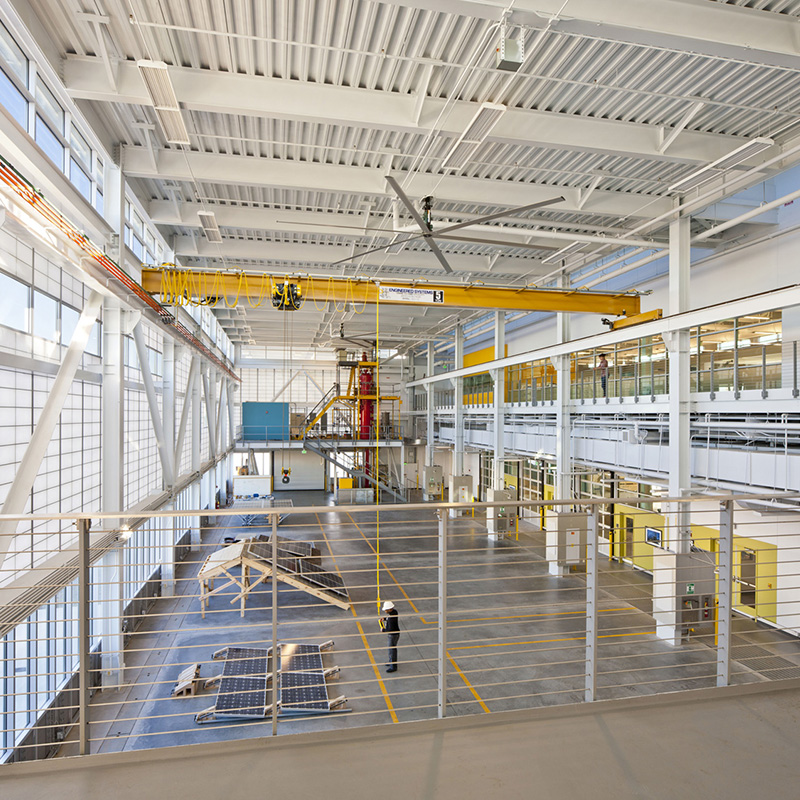
Carbon Neutral Energy Solutions Laboratory
Built in 2012, the Carbon Neutral Energy Solutions (CNES) Laboratory Building is designed to foster industry collaboration and support translational and pre-commercial research in clean, low-carbon energy technologies.
Low-Carbon Features
While the idea for CNES was to build a space that brings together people working on low-carbon energy, Georgia Tech also wanted to make the building itself a demonstration for applied low-carbon energy technologies. The CNES building is a living lab with an innovative “no frills” design and net-zero carbon emissions. The 42,000-square-foot facility is intended to set a new standard for sustainable design for buildings of its type by optimizing passive energy technologies, reducing electricity loads, and maximizing the use of renewable energy.
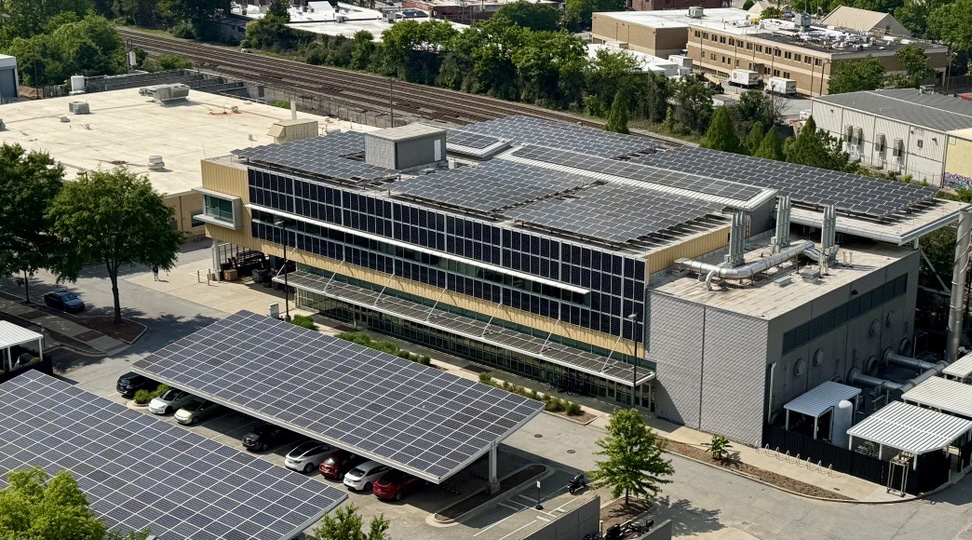
Rooftop Solar Array
The solar array generates 396,000 kilowatt hours per year of electricity, offsetting the building’s energy needs.
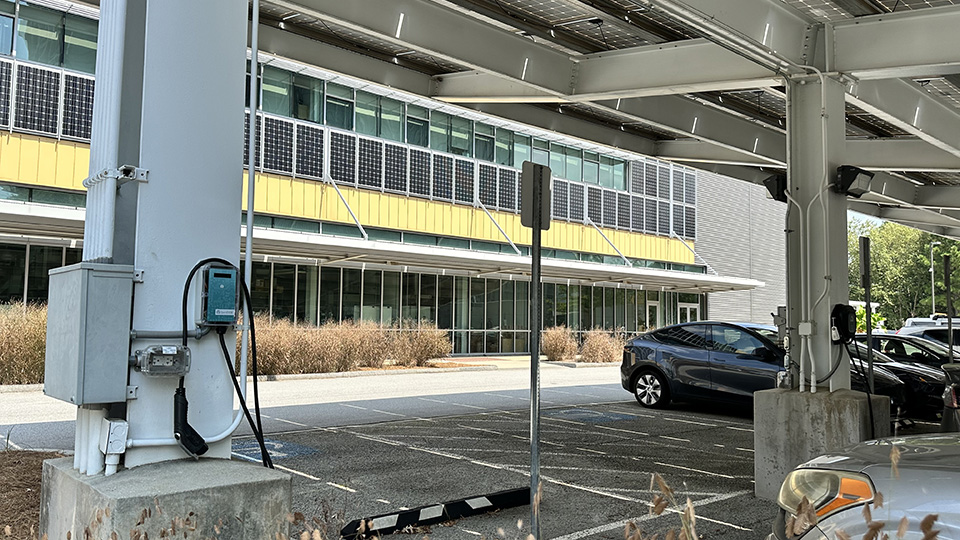
DER Living Lab on Campus
With rooftop solar arrays, a Stryten Lead BESS system, and EV charging stations in the parking lot, CNES is a hands-on hub for live experiments in distributed energy resources (DER).
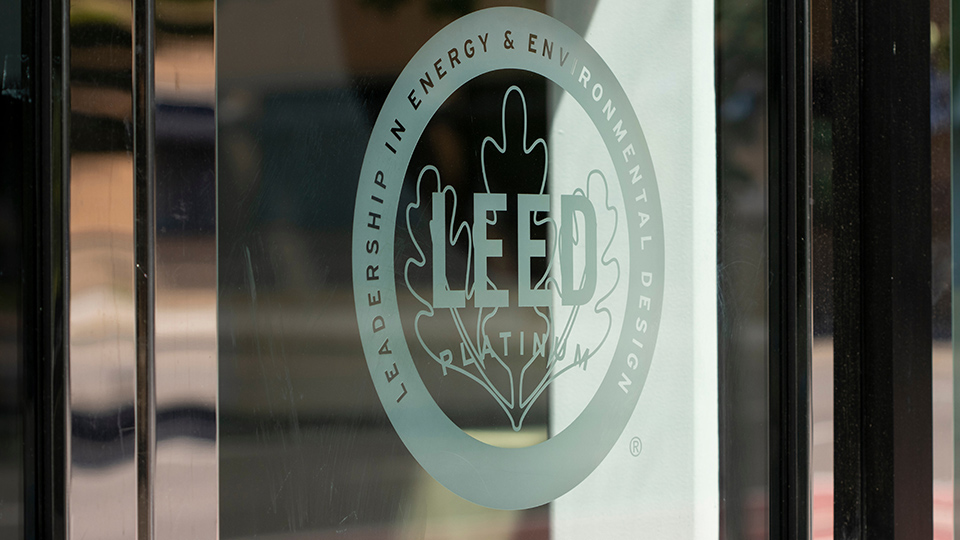
Certified as LEED Platinum
CNES is the first Georgia Tech building to be certified by the U.S. Green Building Council.
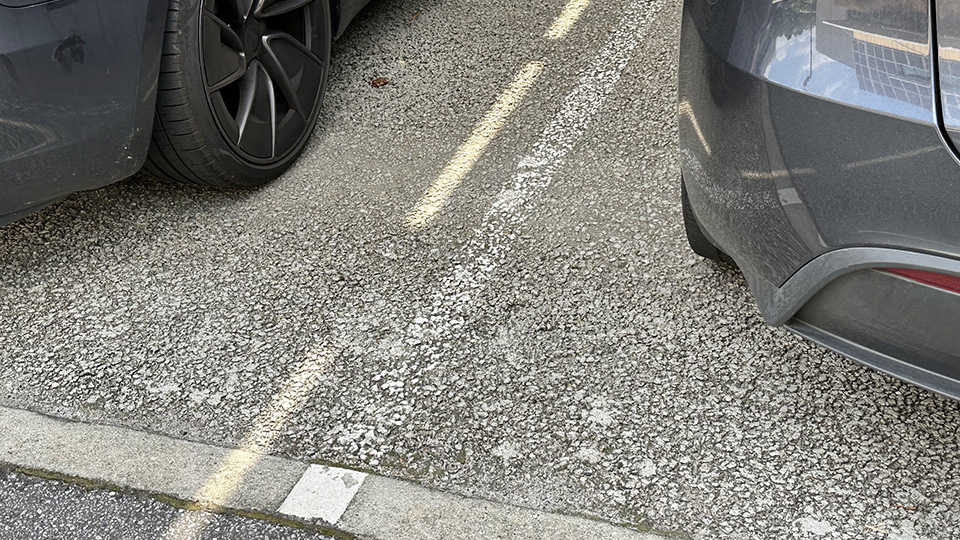
Permeable Surfaces
The surface of the parking lot is permeable to minimize storm water run-off and collect rain water for repurposing within the building.
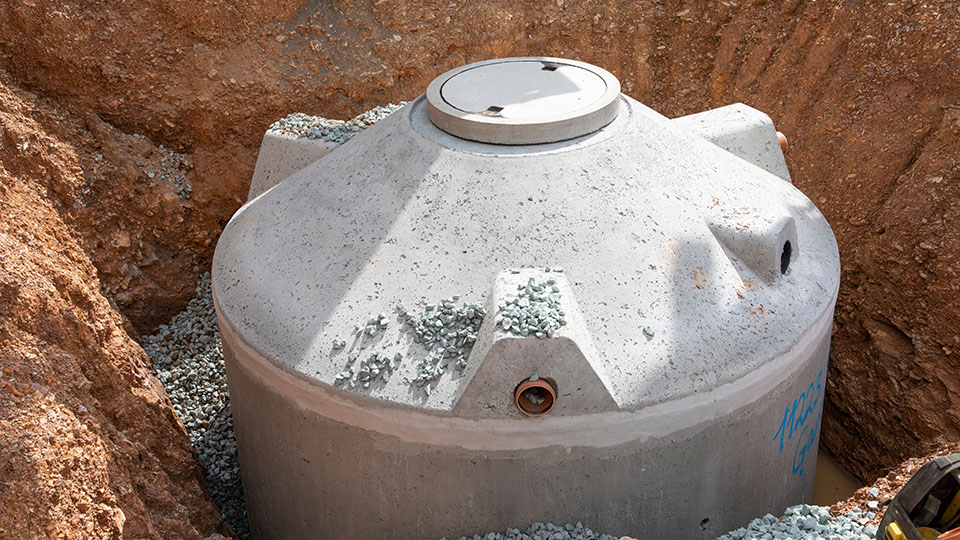
On-site Cistern
The onsite cistern collects rainwater from the rooftop of the building and the the parking lot pavers for holding and stormwater management.
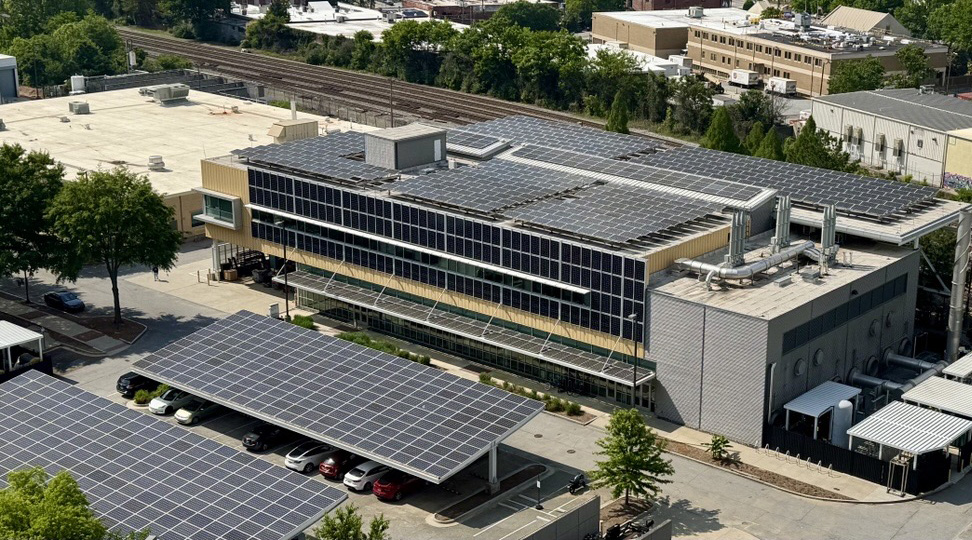
Net Positive Energy
CNES produces more energy than it consumes during peak solar production times. The excess energy is redistributed to campus for consumption.
Research Groups
Research at CNES spans all aspects of the energy cycle for both renewable and fossil fuel based energy sources making it the hub of applied energy research at Georgia Tech. Core research conducted within the lab includes, solar technologies, combustion, gasification, catalysis and bio-catalysis, sustainable chemical processes, as well as carbon capture and sequestration. Some of the key research areas housed within CNES include
- High-efficiency combustion systems
- Alternative fuels and renewable energy systems
- Biomass gasification
- Advanced catalytic and gas separations technologies
- Capture and recycling of carbon from power plants and combustion engines.
Please click the links below to learn more about the individual research groups working out of the CNES building.
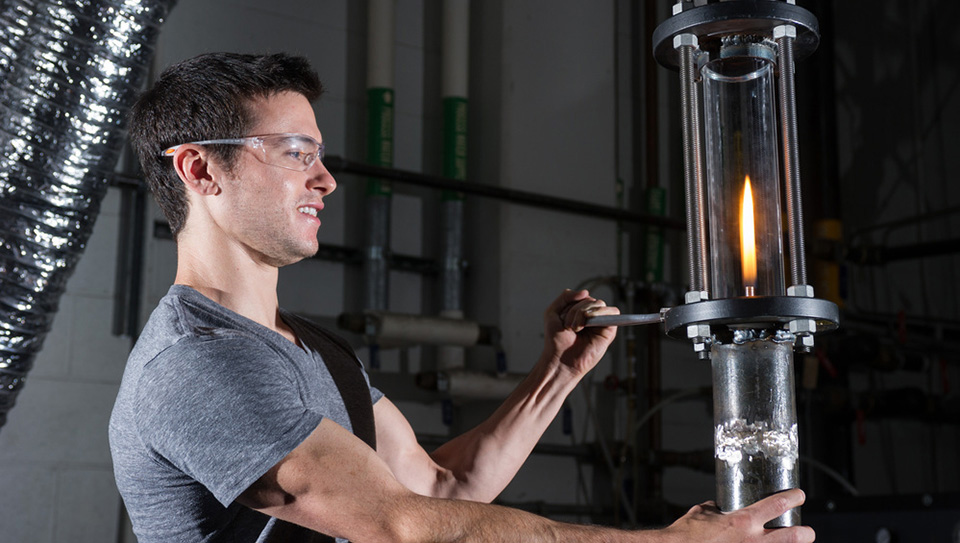
Sustainable Aviation Research
Research on clean aviation combustion, sustainable engines, and fuel testing to assess how fuel properties affect combustor performance and emissions.
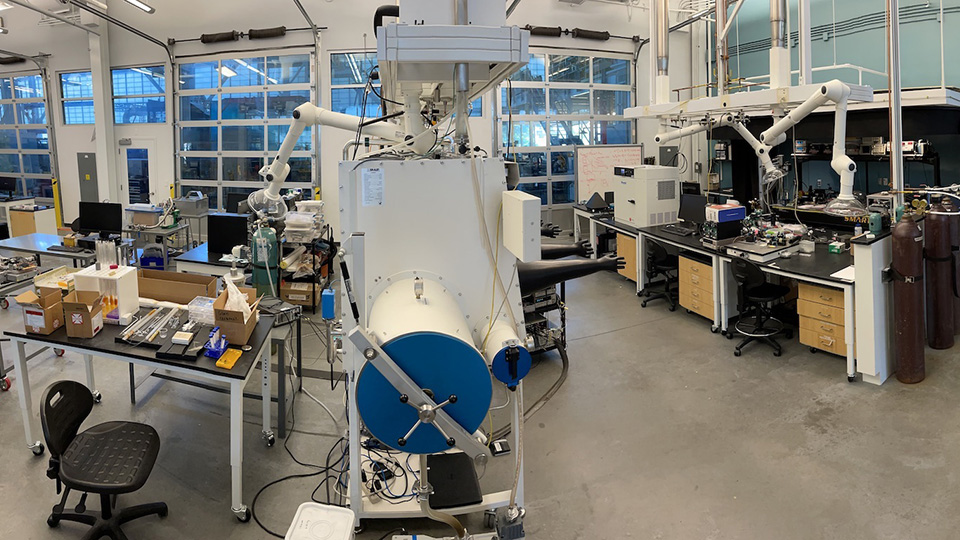
High-efficiency Combustion Systems
The Scalable Thermal Energy Engineering Laboratory (STEEL) at CNES develops thermal energy conversion technologies and thermal transport technologies.
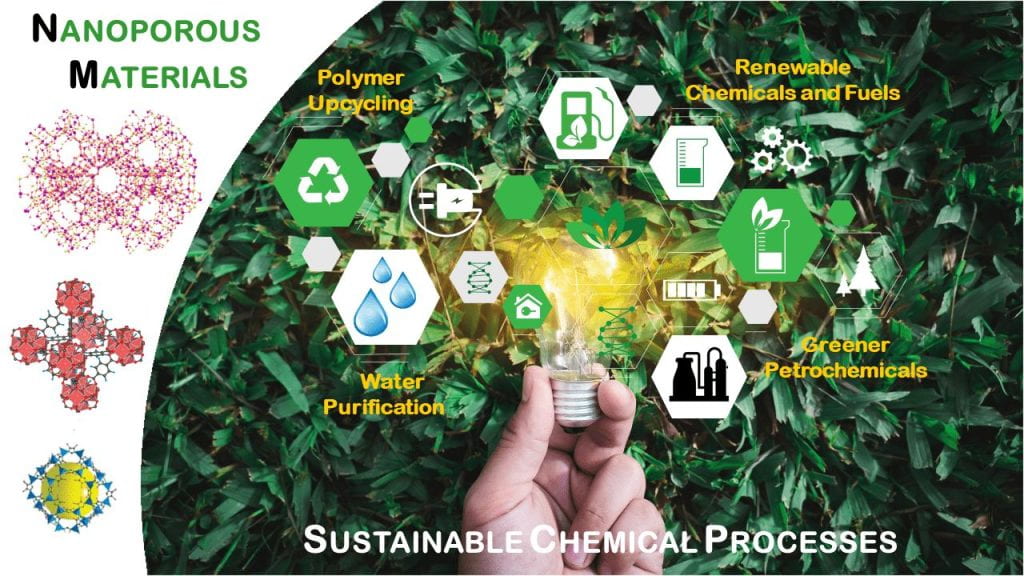
Chemical Processes for Renewable Energy
Basic and applied problems relating to renewable/clean energy, carbon capture, advanced separations, catalytic membranes, and nanoscale sensors.
Plasma Instrumentation and Engineering Research
Research that focuses on the study of magnetized plasmas for space propulsion, plasma-assisted materials deposition, and energy production.
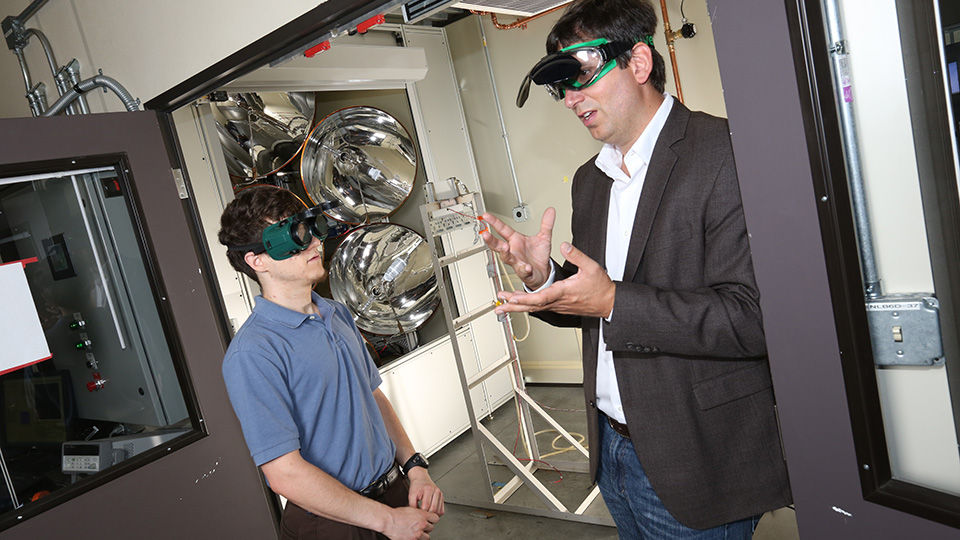
Heat Transfer, Combustion, and Energy Systems
Research that focuses on concentrating and storing sunlight in a chemical form, i.e., solar fuels
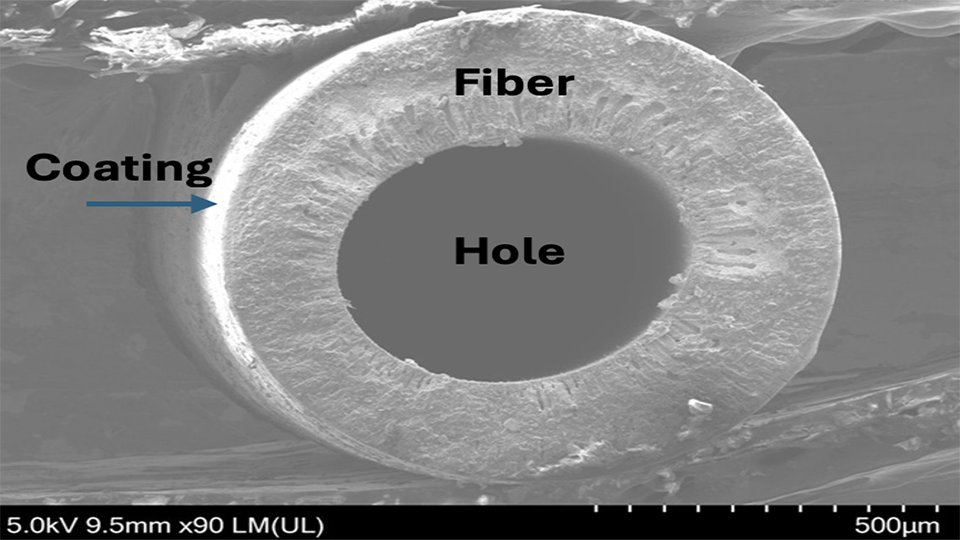
Scalable Fabrication Techniques for Advanced Manufacturing
Research on scalable, roll-to-roll manufacturing processes for use in energy systems (fuel cells), electronics, and environmental applications.
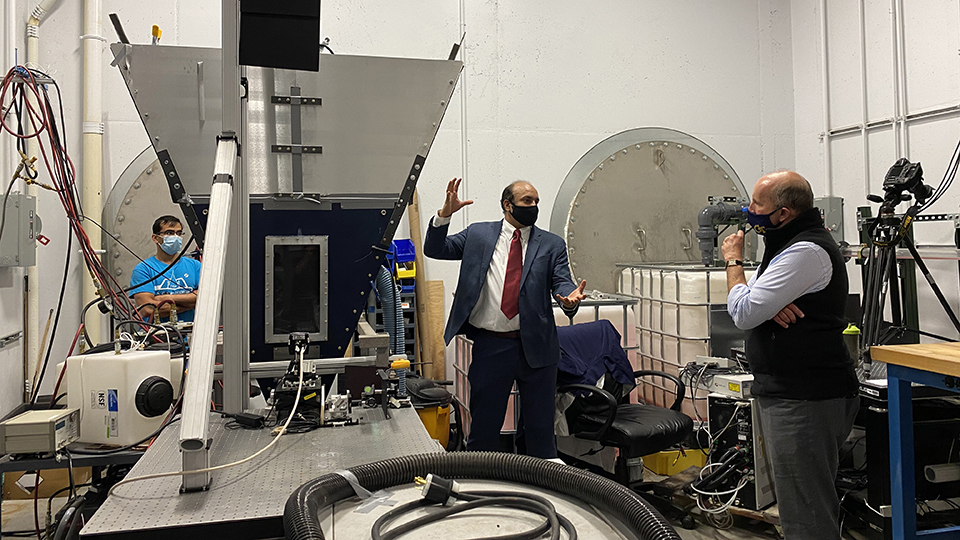
Hydrodynamic Instabilities and Turbulent Mixing
The STAM lab explores fluid instabilities and mixing to advance energy technologies and fundamental flow physics.
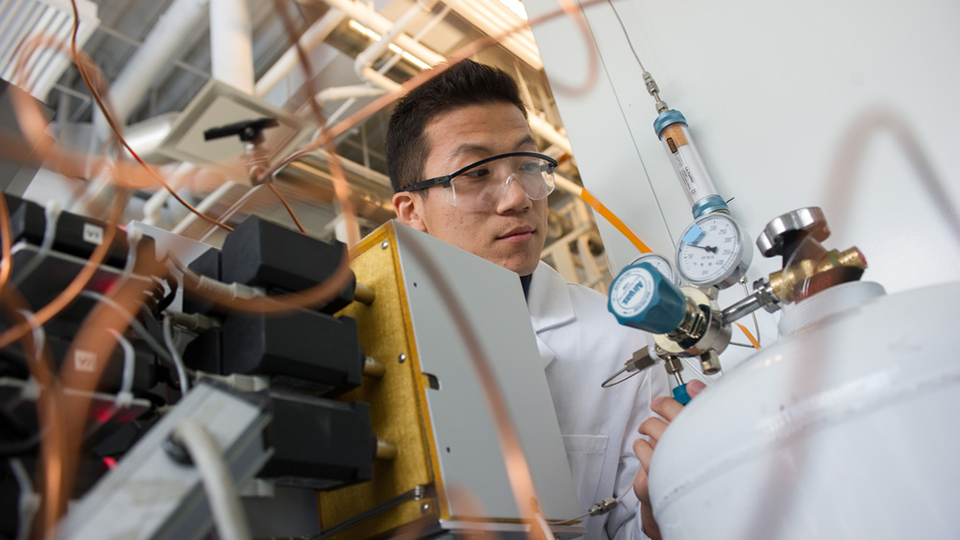
Energy-Water Systems
Exploring energy-water challenges through advanced materials, thermal systems, and synergistic phase-change innovations.
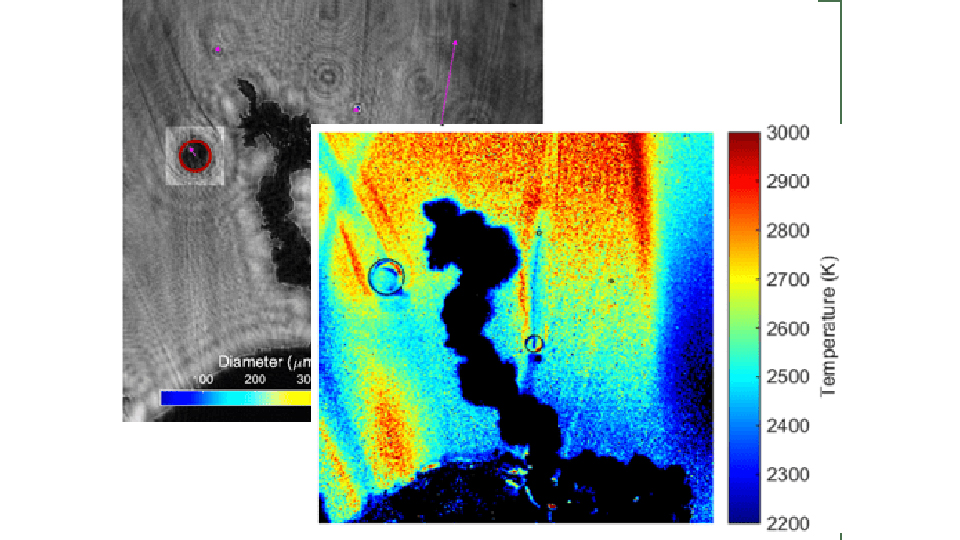
Laser Diagnostics, Combustion, Detonations, and Energetic Materials
Research that focuses on using laser diagnostic techniques for studying combustion phenomena, gas-phase and multi-phase detonations, and solid energetic materials
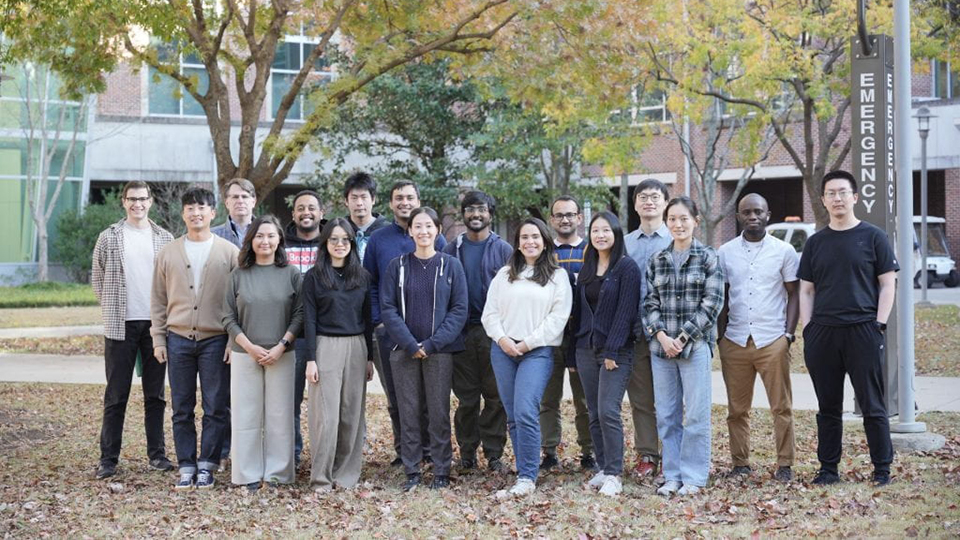
Advanced Catalytic and Gas Separations Technologies
Research that specializes in synthetic chemistry applied to chemical engineering applications in catalysis and separations and capture of CO2 from air.
Facilities
Floor Plan
Equipment
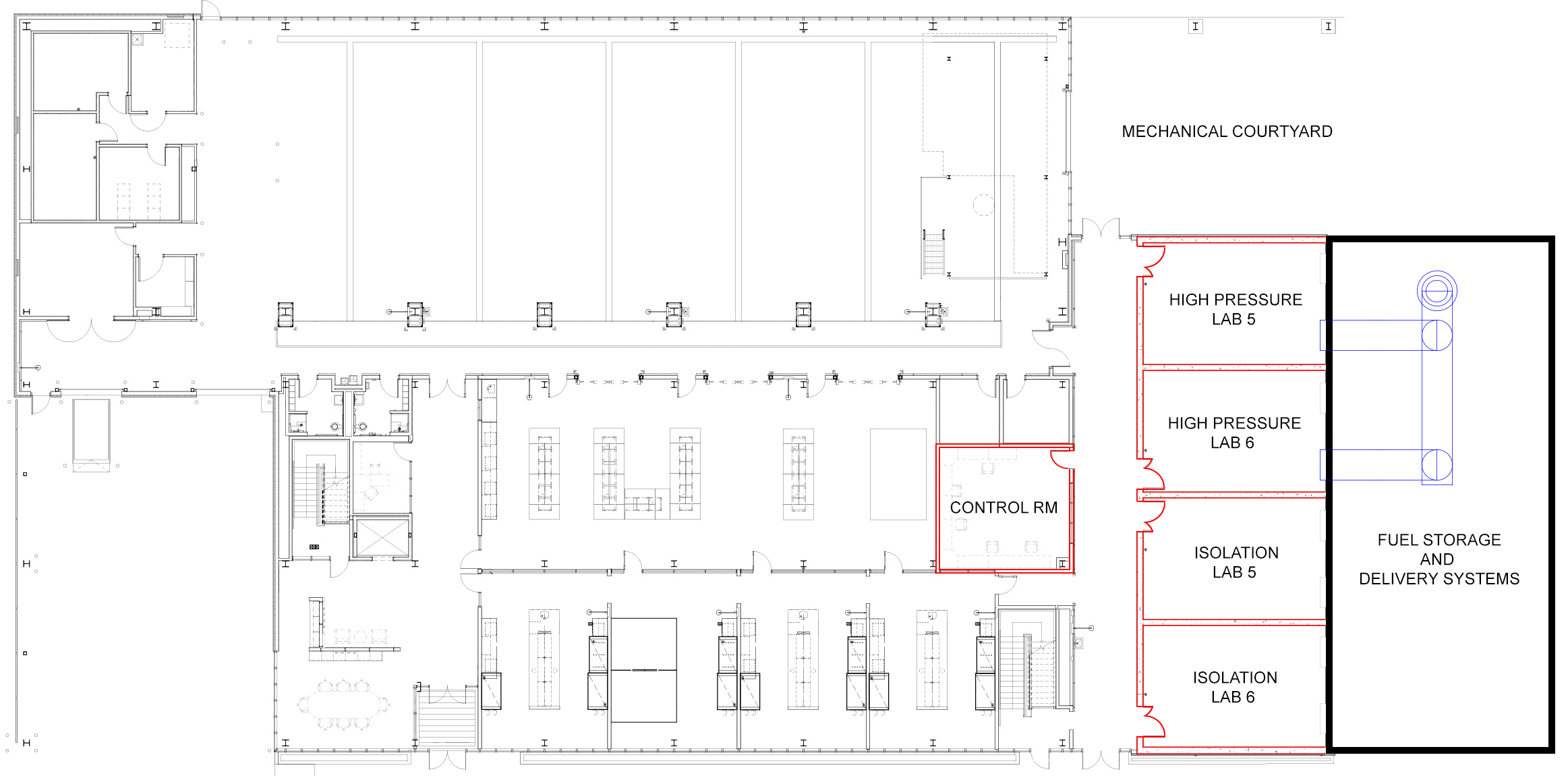
The Carbon Neutral Energy Solutions Laboratory is an academic research facility dedicated to using the latest diagnostic tools for the study of energy technologies. The facility is equipped with an open laboratory with a number of test stations, each equipped with electrical power, intermediate-pressure air supply, pressurized natural gas, and other amenities. The lab space also consists of isolation rooms, which are equipped similarly to the open lab, but which are optically and acoustically isolated from the rest of the lab. CNES has two high pressure labs and two isolation labs.
Process Air System
Process Air Heaters
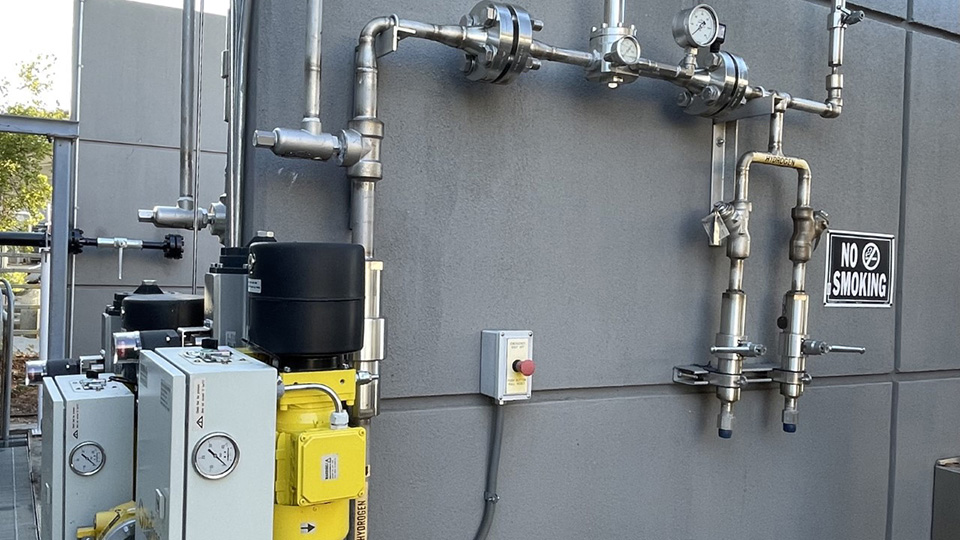
Fuel Delivery Systems
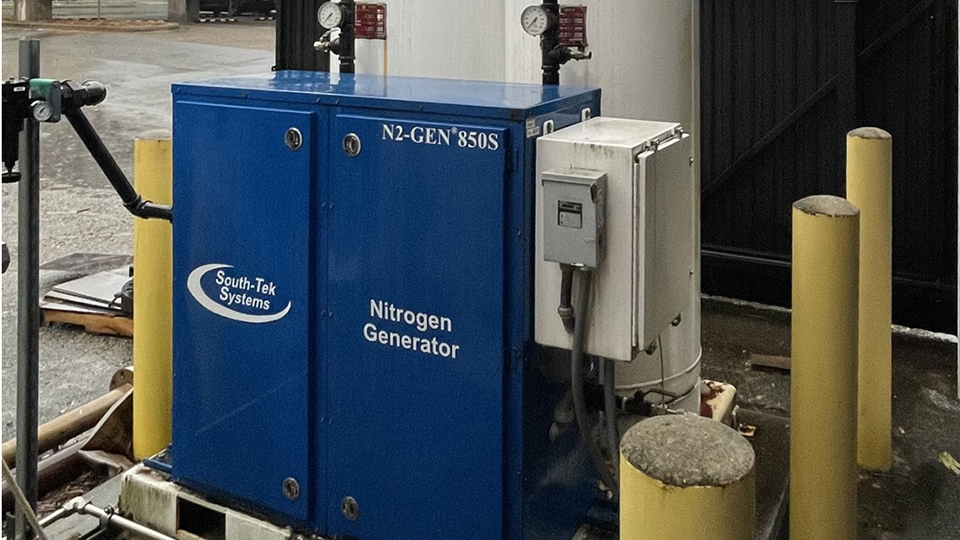
Nitrogen System
Machine Shop Information
Click the button below to access information related to the CNES machine shop.
CNES Contacts
The CNES building is part of the North Avenue Research Area (NARA) section of the Georgia Tech campus.
Building Contacts
Carbon Neutral Energy Solutions Lab (CNES) – Building 199
Primary Contact: Tyler Pennel
Title: Building Coordinator – Carbon Neutral Energy Solutions Lab
Affiliation: Strategic Energy Institute | Georgia Institute of Technology
Location: 635 Strong Street, Atlanta, GA 30318 | Room 112 (BTZ)
Email: tpennel3@gatech.edu
Phone: (720) 442-6313
Secondary Contact: Kristopher Manion
Title: Lab Manager II – North Avenue Research Area
Affiliation: College of Engineering | Georgia Institute of Technology
Location: 495 Tech Way NW, Atlanta, GA 30318 | Room 108 (CNES)
Email: kristopher.manion@gatech.edu
Phone: (678) 596-6976
NARA Complex
Primary Contact: Kristopher Manion
Title: Lab Manager II - North Avenue Research Area
Supports Operations at: BTZ, CNES and other COE NARA buildings
Affiliation: College of Engineering | Georgia Institute of Technology
Location: 495 Tech Way NW, Atlanta, GA 30318 | Room 108 (CNES)
Email: kristopher.manion@gatech.edu
Phone: (678) 596-6976
Ben T. Zinn Combustion Laboratory - Building 151
Primary Contact: Aaron Lynch
Title: Facilities Manager – Ben T. Zinn Combustion Lab
Affiliation: Aerospace Engineering | Georgia Institute of Technology
Location: 635 Strong Street, Atlanta, GA 30318 | Room 112
Email: alynch72@gatech.edu
Phone: (937) 368-8169
Secondary Contact: Matthew Kohn
Title: Lab & Facilities Coordinator – Ben T. Zinn Combustion Lab
Affiliation: Aerospace Engineering | Georgia Institute of Technology
Location: 635 Strong Street, Atlanta, GA 30318 | Room 112 (BTZ)
Email: matthew.kohn@gatech.edu
Phone: (404) 807-2702
Buzzcard Access
All individuals entering the building must have their Buzzcard information registered in the building access database. Please contact Kristopher Manion or Tyler Pennel if you need access.
All other visitors and guests must be accompanied at all times by a Georgia Tech team member with building access.
Tours
Tours of CNES are available on request and subject to availability and safety and security protocols. Contact Kristopher Manion for more information. Please refer to the CNES Lab Tour SOP for details.
View Video Transcript
Carbon Neutral Energy Solutions Lab
Video Summary: Tim Lieuwen, Director of the Strategic Energy Institute, and Chris Jones, New-Vision Professor of Chemical and Biomolecular Engineering, showcase Georgia Tech’s Carbon Neutral Energy Solutions (CNES) building. The facility brings together researchers from across campus who are developing low-carbon energy technologies, including carbon capture, biofuels, hydrogen production, combustion systems, and sustainable energy solutions. The building itself serves as a living demonstration of low-carbon design and operates with net-zero electrical plug load through rooftop solar generation.
Speakers: Tim Lieuwen, Former Director, Strategic Energy Institute (currently Executive Vice President for Research, Georgia Tech); and Chris Jones, New-Vision Professor, School of Chemical and Biomolecular Engineering.
Tim Lieuwen, Former Director, Strategic Energy Institute: This is the Carbon Neutral Energy Solutions building, and the idea of this building was to bring together researchers across campus who are working in low-carbon energy.
Chris Jones, New-Vision Professor, School of Chemical and Biomolecular Engineering: The goal of my research in carbon capture is to develop materials and technologies that will reduce the cost of carbon dioxide separation from a variety of gas streams, including exhaust gases from electricity-generating power plants.
There is also quite a bit of work in biofuels and, more generally, making clean fuels, whether they are alternative fuels or fuels derived from hydrocarbons. One example is the gasifier, which is designed to convert solid materials such as coal or biomass into gaseous fuels, including hydrogen.
Tim Lieuwen, Former Director, Strategic Energy Institute: The building brings together a variety of flexible research features. We have a mid-bay area for wet laboratories and related research activities, as well as a high-bay space for large-scale experimental systems. We also have extensive capabilities for conducting high-pressure, high-flow, and low-emissions combustion testing.
The Strategic Energy Institute is housed in this building as well, and its objective is to coordinate and strengthen Georgia Tech’s energy research community.
There is an enormous amount of capability here. This building represents a major advancement for Georgia Tech because it allows researchers from different disciplines and programs to be co-located while working on strategic energy challenges. By bringing these groups together, we encourage cross-pollination of ideas and more effective collaborations.
Chris Jones, New-Vision Professor, School of Chemical and Biomolecular Engineering: The vision for this building was not only to bring together researchers working on low-carbon energy technologies, but also to make the building itself a demonstration project for low-carbon design.
This facility operates with net-zero electrical plug load. One hundred percent of the electricity used by the building’s occupants is provided by rooftop solar panels. Those solar panels are based on technology that was developed at Georgia Tech and later commercialized through a Georgia Tech spinout company.
As a chemical engineer, our role is to develop advanced materials and then integrate those materials into processes that can become commercially viable technologies with a direct positive impact on society.
Tim Lieuwen, Former Director, Strategic Energy Institute: Another major focus of the Strategic Energy Institute is growing resources for the Georgia Tech energy community, ensuring that we respond effectively to large external funding opportunities, and strengthening our thought leadership on critical energy challenges.